The GPS fleet system one of our guys built
Chapter two: a gym conversation, a fast start, and the GPS fleet page that now lives inside Ignition, the ops system we build for ourselves.
"He's really into gaming."
That's what a friend of my dad's told me about his son when I ran into him at the gym. My dad and his dad are friends, so it wasn't a cold introduction. That was in mid-April.
A few days later, on April 20, his son came in, and he started that same day. I could tell he understood what was possible with AI. He made comments and asked questions that most people I talked to back then didn't understand yet.
After his first week, I told his dad that his son had been training for this his entire life.
About two months in, he had the first working version of our GPS fleet system running. Today it lives inside Ignition, the ops system we build for ourselves, as the GPS fleet page.
At the end of chapter one I said I'd write about the GPS fleet system one of our guys built. This is that story. Chapter one was mostly Josh and me. This one is about what happens when somebody else in the building starts building too.
If you missed chapter one
Service Fire is a fire sprinkler company. We started in 1995, we're still heavy in installs, and in 2024 my dad challenged me to build a service department. Service is the work that comes after the install: inspections, testing and repairs on systems already in a building.
Since then we've built our own operations system, Ignition, with Josh, our lead dev. Leads, proposals, jobs and inspections all run through it. Chapter one tells how that happened, starting with a backflow test and a paper check: Chapter one: "Let's build a service department."
Austin Rodgers
His name is Austin Rodgers. He started at Service Fire on April 20, 2026. He was brought in to be Josh's assistant, his helper.
What we were dealing with before
Before the fleet system, nobody could see where the trucks were, how they were being driven, or what shape the engines were in without calling someone or waiting for a problem to show up. Austin built it so the dispatcher gets a live map of named trucks, the office gets engine health and mileage for maintenance scheduling, and we get driver behavior data: speeding, hard braking, idling. The alternative was paying a vendor a monthly per-truck fee under a multi-year contract, with the data living in their system instead of ours.
Wasted trips kill service profits. Before this, we'd send a tech out without the full picture, and sometimes two trucks would pass each other headed in opposite directions.
Service work runs on driving. Every inspection, test and repair starts with a truck going to a building. New installation still drives our business right now, but we're working to make service the main revenue source.
About two months in
About two months after he started, he had the first working version running. The earliest real position on record is June 11, 2026, from a tech's truck in Dallas, used as the example in the first spec Austin sent to Josh. Engine data from the truck's computer went live on July 3, 2026. In Austin's words: "The first version was live seven weeks after my start date."
He shopped vendors first, then built in-house. Getting the hardware was the hard part. The first unit was the wrong regional variant and couldn't hear US cell towers. He cold-called until the maker's US sales contact agreed to meet him at a Dallas warehouse and sell him a single US unit. A SIM seated in the wrong adapter frame cost more time. He wrote a spec for Josh and they traded documents until the handoff was locked. Austin's side sends everything the truck produces, raw and complete. Josh's Ignition decides what to show, names the trucks, assigns drivers, converts units, and builds the maintenance features on top.
A few things broke or surprised him along the way. The European model that couldn't hear American cell bands. Manufacturers that wouldn't sell without a volume contract. The SIM in the wrong adapter. Devices that log two or three records in the same second, so a normal duplicate check would throw real data away and the handoff had to use a unique record ID. A VIN that arrives scrambled into a giant number by how the protocol encodes text. Fuel level readings from the truck's own sensor that jump 20 or 30 percent within minutes and need smoothing before anyone trusts them. And the devices won't power on over USB, so every bench test meant a 12-volt battery on the desk.
Austin put the build approach this way: "I did not write the code by hand. I described what I needed in plain English, reviewed what came back, tested it locally, and deployed it. ... Two months earlier I did not know what a webhook was."
When Josh first saw it, he was honestly super impressed. They'd given Austin very little to start with: almost no instruction on how to get going with code, just "do some research." Austin picked up how building with an AI coding tool actually works very quickly, how to go back and forth with it and keep iterating. Before Josh knew it, he had a full working application. "I was mind-blown," Josh said.
How it ended up in Ignition
In chapter one I wrote that we stopped building separate apps and started building one connected system. The GPS fleet page is part of that system now. Austin's tracker stayed his system on the GPS side. He wrote the spec for how it would talk to Ignition, and it sends truck positions in through a webhook. On the Ignition side Josh built three views on that data: a live map for dispatch, a vehicle roster, and a management dashboard that tells each truck's day in plain language: left the yard at 6:30, five and a half hours on site, home by 4. What changed is that leadership went from having no real picture of the fleet to seeing it in the same system they use to run jobs.
Josh put it this way: "Austin built the engine; we gave it a home where everyone already works."
What it does today
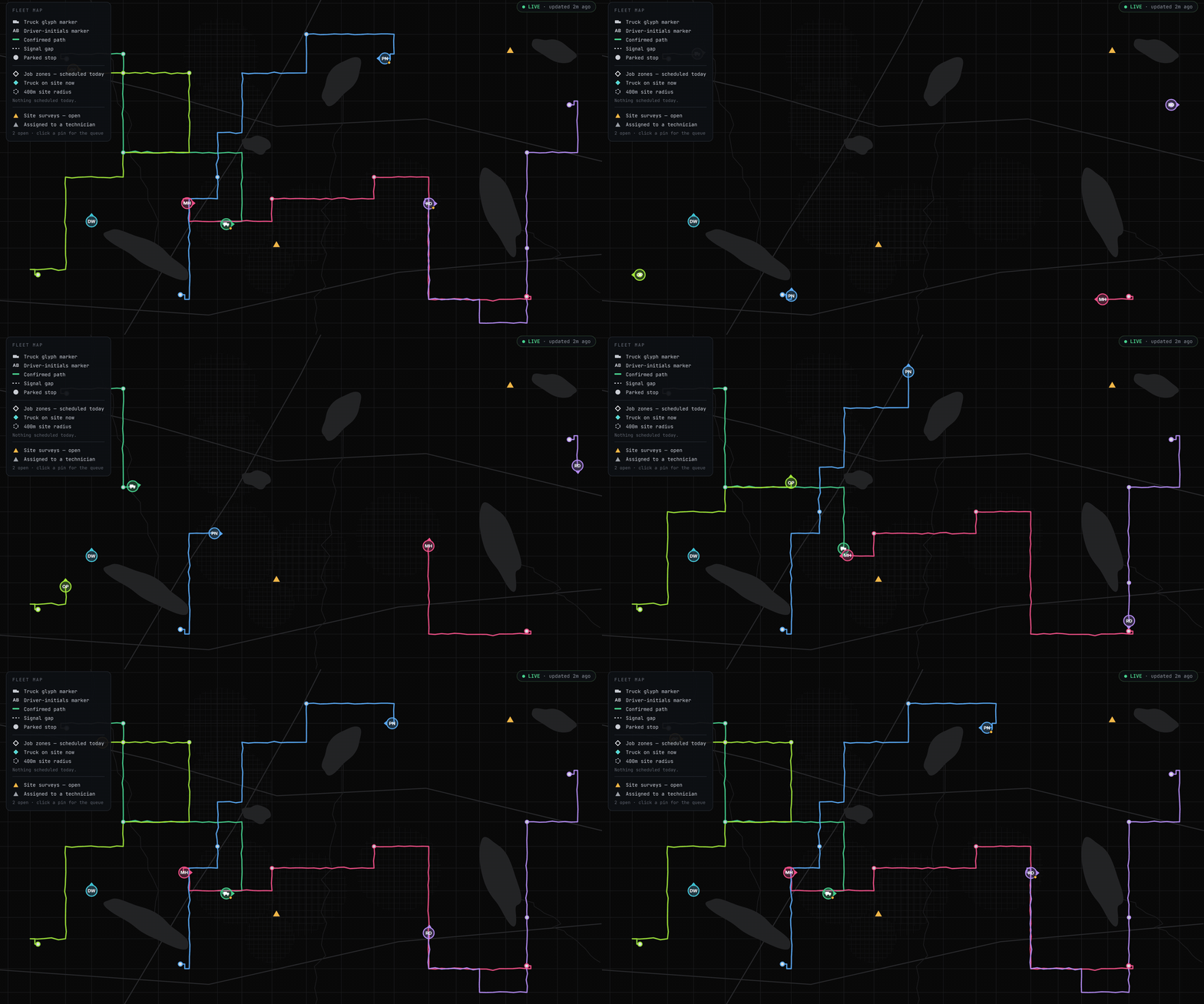
So far it tracks seven trucks live, around the clock. Each tracker plugs into the truck's diagnostic port, sends its position over cellular to a server in Dallas, and that server saves every record and forwards it to Josh's Ignition system within about a second. When a truck is running it also sends engine data: odometer, fuel level, coolant temperature, RPM, engine load, battery voltage, and fault codes. By Austin's count, it had handled over 536,000 positions as of early October. Every day the dispatcher sees named trucks on the Ignition fleet map; Josh's maintenance and driver-behavior features in Ignition run on the data; Austin watches the pipeline dashboard for system health.
The real page shows a live map of our trucks by name, with engine data whenever a truck is running. The demo above uses the same components with made-up data.
Me, I use it to push suggestions and feature requests to Josh for Ignition.
I'm not going to put a fuel, drive-time or hours number on it until we can pull one from Ignition or our fuel-card data. What I can tell you is that we had no idea what our data really looked like, and now we know just about everything.
Why I'm writing about Austin
Michael Lim, who led Alex Hormozi's media team, asked a question on The 505 Podcast that stuck with me: "Does every single person on your team feel like the hero in the story of your company?"
Chapter one made it sound like two people. That's not the whole story. Ignition is built around how people here actually work. Sometimes that means Josh goes back and forth with a department until the page fits. Sometimes it means somebody inside the company builds the thing himself.
In chapter one I argued that a shop that builds its own ops layer can run leaner than the private equity model can. That ops layer isn't only Josh and me.
In Josh's words from chapter one: "When you can go deep into one business and tailor everything around it, that's where the magic is." A GPS fleet page built by Austin Rodgers, for our trucks, inside our own system, is what that looks like in practice.
If you're an owner thinking about hiring someone who's into AI: good luck, and get your own team going. That part is absolutely critical.
What's next
Josh decides what goes into Ignition, and that won't change. The fleet system is still evolving, and right now there's still a bit of a bottleneck around him, but the walls are coming down quickly.
Next I'll write about those Tuesdays and Thursdays: what it looks like when almost every meeting has a new feature to demo. Subscribe and you'll get it.
Thanks to Austin Rodgers and Josh, our lead dev, whose interviews (Austin: 2026-10-03; Josh: 2026-10-05) supplied the details and every line I quote from them. Michael Lim quote: The 505 Podcast, episode 190.